
How to photograph tulip fields at golden hour

With Robin

In this article, Robin breaks down how he photographs golden hour tulip fields — timing the light, working with the fog, and knowing exactly when to take the shot — using his Best of the Week photo as the case study

@robin.dxll_Tulip_fields_Winning Photo
When I was little, I had no interest in photography or making art. I only came into contact with it because of my father, he always brought his camera along when we went on vacation, and even then it didn’t really spark my interest. I didn’t bother to ask any questions. Eventually it was simply normal that he brought his camera.
 
What actually pulled me in came later, and from somewhere else entirely: the weather. When I got older, I found interest in storm chasing, finding comfort in nature’s sheer power. I spent a lot of time privately studying and learning until, about two years ago, I wanted to start capturing each breathtaking storm, night sky, sunset, and flower field there is to find. I yearned to capture each moment dear to me and share those special moments with people equally as passionate as me. It occurred to me that I didn’t want to only save those moments as a memory, I wanted a physical piece of evidence of each wonderful place and event our planet has to offer. That mindset is behind every shot in this guide, including the golden hour tulip field below.
@robin.dxll_Nomadict_Netherlands

Timing and patience: Why both matter

In the years I spent learning about photography, and in the moments I put that knowledge into practice, one thing was always clear: try to be the first at every given moment and spot, so you don’t miss the best parts of it. But being early isn’t enough on its own, you still need the patience to wait for the big moment to come, and the right second to take the final picture. That’s why timing and patience will always go hand in hand.

You wouldn’t want to miss the peak of a sunset because you weren’t ready earlier, or because you left before the final rays of sunshine disappeared behind the horizon. Golden hour tulip fields work the same way. Arriving early gets you in position; patience is what gets you the shot.

Let nature light the shot

A big key element, especially around sunrise and sunset, is using nature’s own lighting to your advantage instead of bringing manmade light. Be patient and look for the right moment, that could be light reflecting in water, the sun shining through the crown of a tree, or the rays of sunshine disappearing behind the horizon, and only then take your picture.

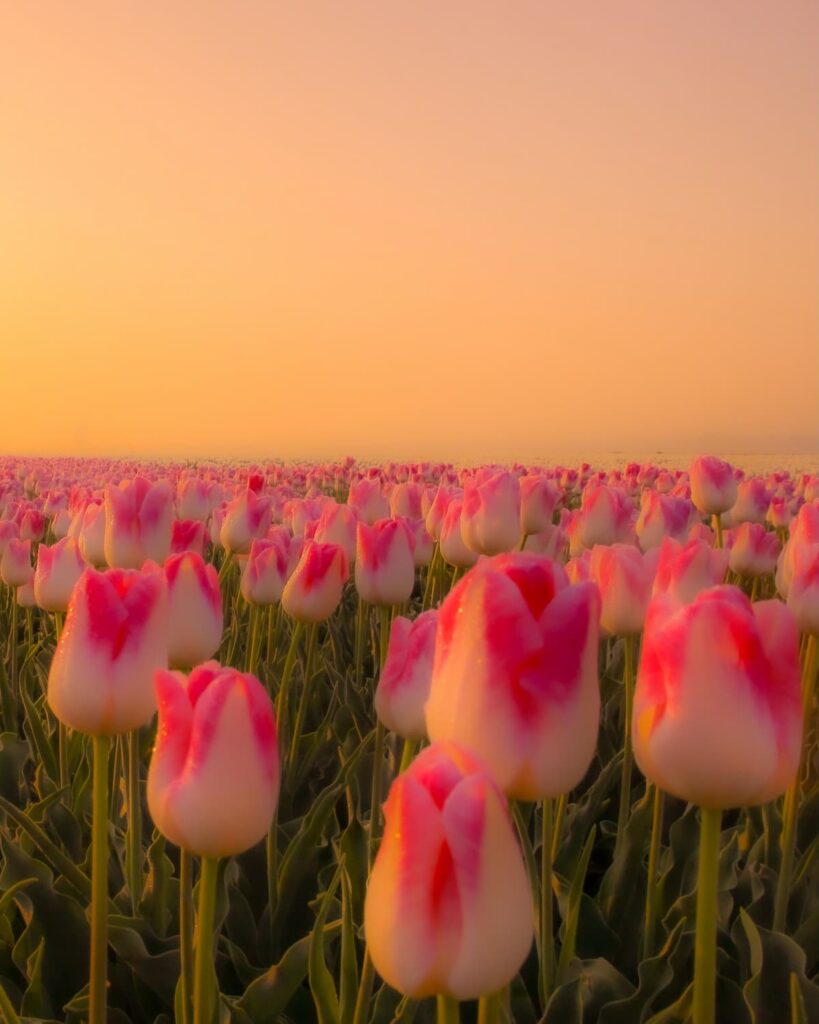
For a tulip field specifically, that means working the window on either side of sunrise: the low, warm angle of the sun is what turns a flat red field into something with real dimension, and no artificial light replicates it convincingly.

Talk to the locals wherever you shoot

Especially on my travels in different countries, one lesson I keep coming back to is to always interact with the locals. The people living in a country know the best spots, the best routes, and sometimes share secret insights you’d never find on your own. I’ve had moments where locals in different countries offered help; a kind man once lent me his bike in the Netherlands when I told him I wanted to reach a certain field of tulips.

It’s not only important to interact with the world around you, but with the people living in it. The best moments are guaranteed if you’re open to welcoming them in.

@robin.dxll_Nomadict Article

Case study: A golden hour tulip field in the Netherlands

(1)

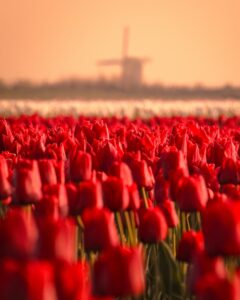
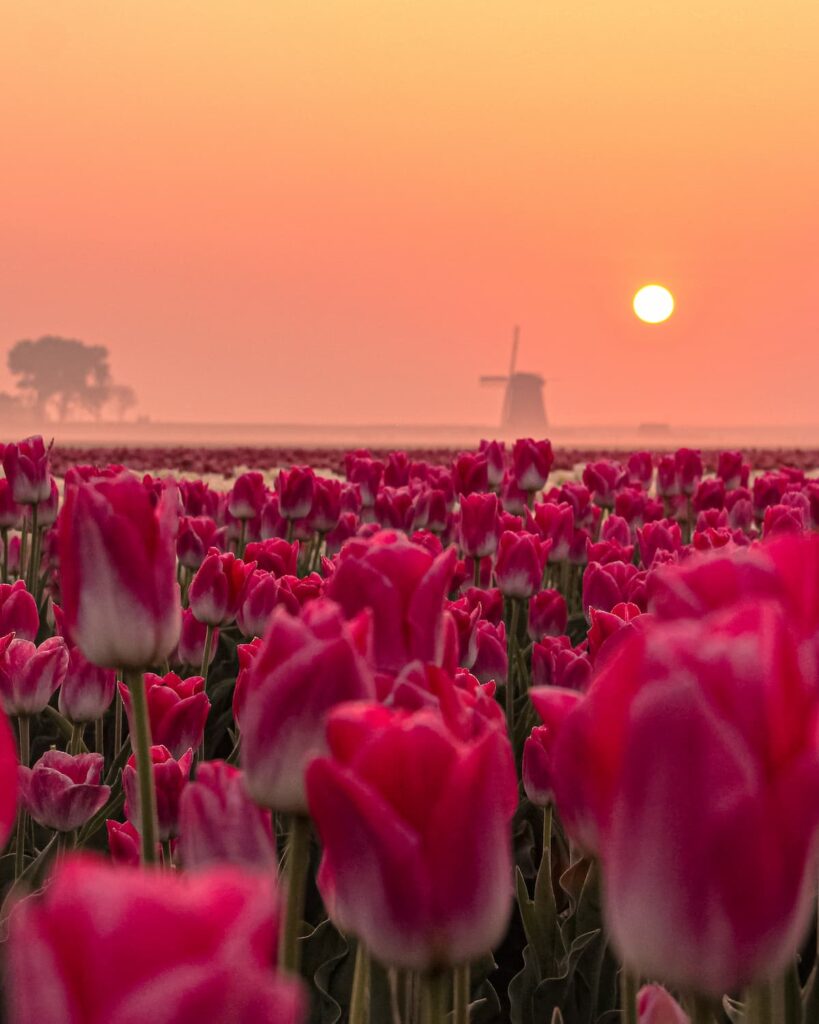
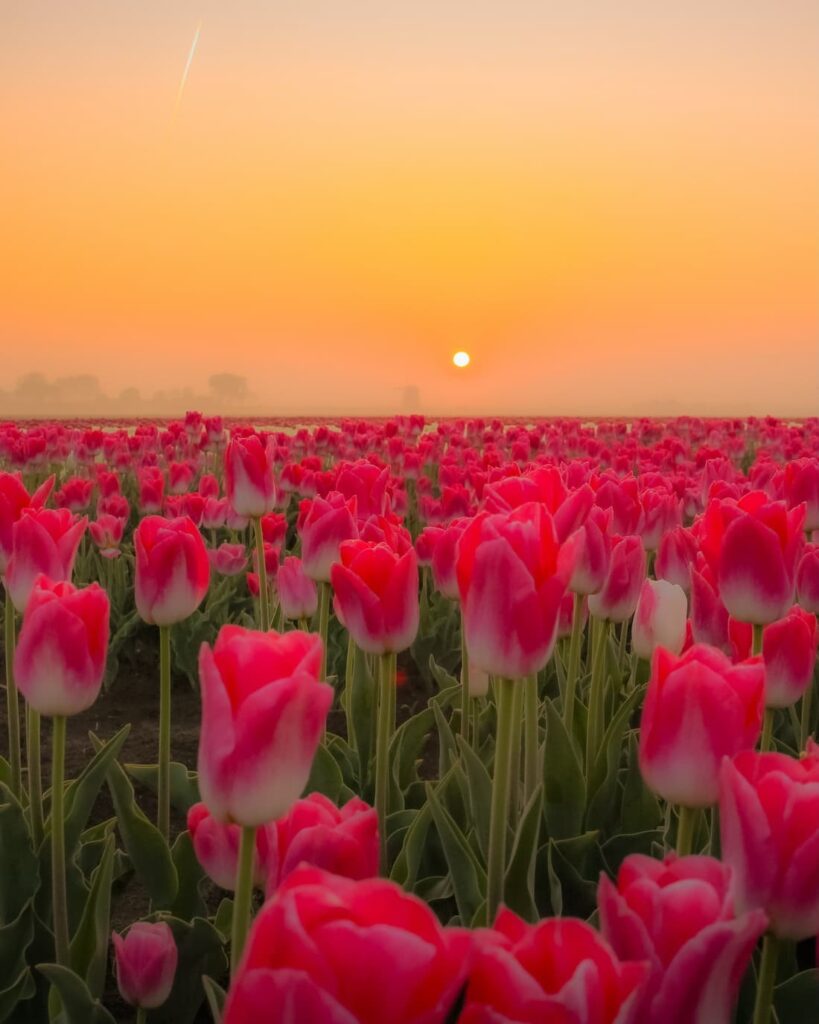
My winning photo came from a very spontaneous trip to the Netherlands in the middle of April, during peak tulip season. The night before going to the fields, I checked the maps for sunrise and fog to make sure my vision of red tulips in golden light could actually come to life.
@robin.dxll_Tulip_fields_Winning Photo

(2)

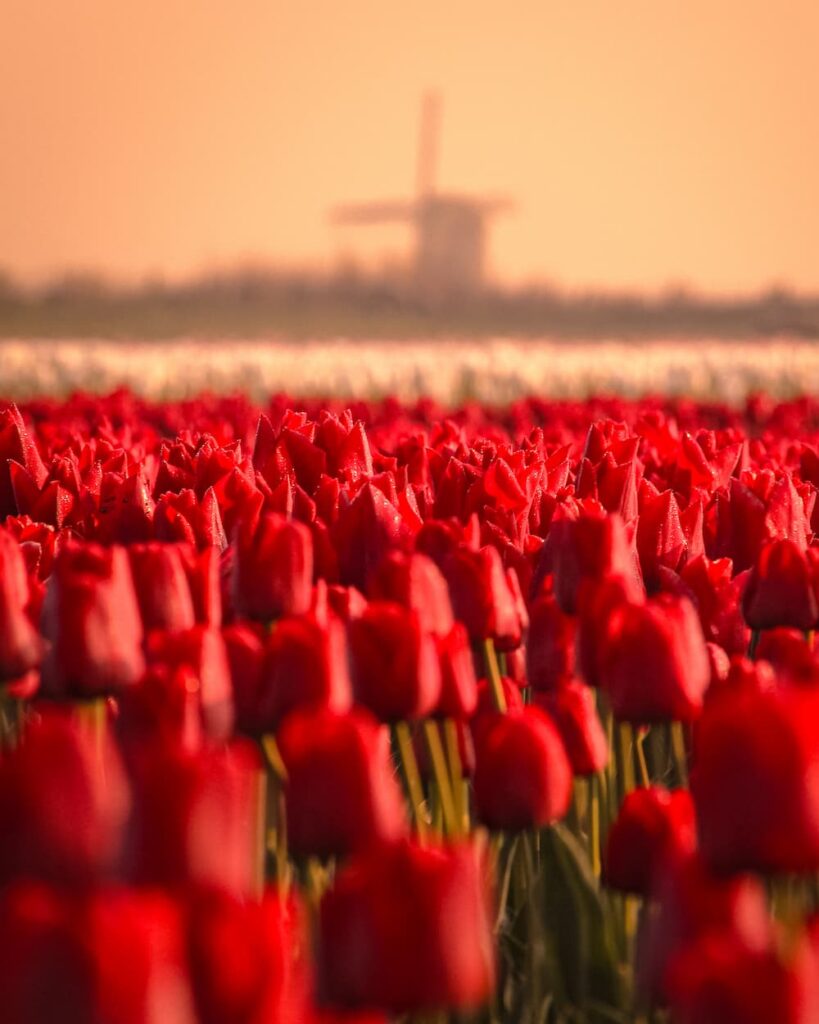
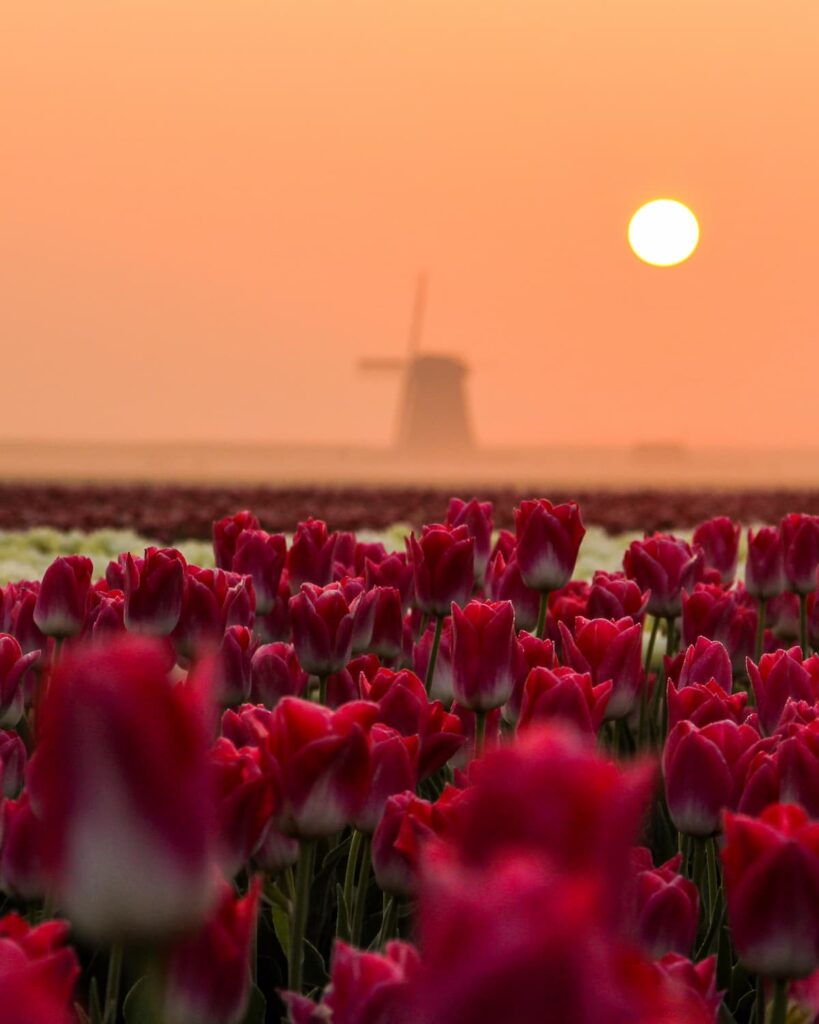
The next morning I got out of bed before sunrise and drove to the location I had in mind — a field where I knew the sun would hit the tulips at the right angle, paired with fog in the background. I set up all my equipment and waited until the sun hit the red tulips at the right angle to give them a golden sheen, and until the fog settled enough to cover the windmill just enough to make the shot feel more mysterious. I wanted it to look like there could be more behind the fog, and to make the viewer speculate about what lies beyond.

(3)

Protecting the peace of those early morning hours was a big part of the image, so I kept the composition simple. The top of the red tulips marks the horizontal middle of the frame, and the windmill marks the exact vertical middle — the two create a cross, and the intersection point does the work of directing the viewer’s eye further into the distance.

(4)

Below that horizontal line, where the red tulips sit, everything is in sharp focus. That’s what gives the effect of closeness, like you could reach out and touch the flowers. Above the line, everything serves as background and is soft, both from the fog and from the camera’s focus, which pushes it further away and makes it feel more cut off from the foreground.
@robin.dxll_Article

(5)

It’s also a low-angle shot, which gives the feeling of kneeling directly in the tulip field and makes the flowers even more tangible. The goal was for anyone looking at the image to feel present in that field, feeling the first morning rays and staring off into an unknown distance. Keeping the composition simple, with clean lines instead of anything complex or dynamic, was a deliberate choice to give the image an extra sense of calmness and peace.

The golden palette

The color story of this shot is built around three tones: a deep, saturated tulip red in the foreground, a warm gold where the low sun catches the petals and the mist, and a soft, muted grey-blue in the fogged-out background where the windmill sits. Getting the exact hex values right means pulling them from the final graded file rather than guessing — worth adding here once the image itself is on hand, so the palette breakdown is accurate rather than approximate.

Editing for golden tones without losing realism

The image came out of the camera slightly underexposed, so the first step was adjusting exposure and depth. The rule I followed: expose for the tulips, not the sky, otherwise the sky overexposes, and so do the shadows. From there I toned down the contrast a little and pulled the highlights into the negative range.

I warmed up the temperature to bring out the golden tones, and adjusted the saturation slightly, but only slightly. Push saturation too far, and the shot starts to look unrealistic fast, which isn’t the goal.

For the effects, I increased texture and clarity a little so the textures could stand out more, and added a touch of haze to emphasize the golden mist in the background.

The aim behind all of these edits was to bring out the full potential of the golden tones. Thanks to the clarity and texture adjustments, the red tulips in the center stayed sharply defined, right down to a few droplets of condensation.

One of the most important steps in the editing process was the crop. My winning image was actually shot in a 16:9 aspect ratio, but since Instagram favors portrait-oriented images, I cropped it to fit. Alongside the crop, the other key steps were adjusting the exposure and depth, and tweaking the color temperature; the same fundamentals that shape every shot in this guide, applied here to one field, one morning, and one very specific window of golden light.

THE LATEST STORIES

WRITEN WITH PASSION TO INSPIRE YOU
@robin.dxll_Tulip_fields_Winning Photo

How to photograph tulip fields at golden hour

In this article, Robin breaks down how he photographs golden hour tulip fields — timing the light, working with the fog, and knowing exactly when to take the shot — using his Best of the Week photo as the case study

Bobby Paulshock Best of the Week Winning Photo @b.pshock

Bobby Paulshock (@b.pshock): Best of the week 8 at #nomadict 2026

In this article, Bobby Paulshock shares how a wife, a dog, and a solo 1 AM hike in a 90-mph Icelandic storm shaped his path from iPhone snapshots to his award-winning aurora shot at Búðakirkja, plus four hard-earned lessons on gear, patience, and building a career from passion.

@withstrk_harz_01-Best of the Week

Christian Stark (@withstrk): Best of the week 4 at #nomadict 2026

Raised on film photography and shaped by years of architectural study at the Bauhaus in Dessau, Christian Stark brings a structural eye and a traveler’s instinct to everything he shoots. Now based in Sweden, he photographs the world from camper van roads across Europe to cold mountain summits in Germany — always with an open mind and often with just one camera.

Mehdi Tadlaoui, @tedmed, Nomadict Winning photo

Mehdi Tadlaoui (@tedmed): Best of the week 2 at #nomadict 2026

Mehdi Tadlaoui is a visual storyteller blending cinematic precision with a refined sense of composition and emotion. Shaped by art, film, and a background in 3D and VFX, he uses photography to explore atmosphere and narrative. This foundation guides his fieldwork, where fleeting moments become carefully composed visual stories.

Sebastian Tan - @quetzalcoatlst - winning image

Sebastian Tan (@quetzalcoatlst): Best of the Week 44 at #nomadict

Driven by a desire to witness the world in its rawest states, Sebastian Tan pursues remote landscapes with patience and precision. Blending meticulous planning with resilience, his work transforms fleeting light into immersive fine art. Recognized internationally, Sebastian bridges the wild and familiar, inviting others to see through his lens.