Photo tour in Azores, Portugal
Join us in the Azores for a unique photo tour, where you’ll elevate your creative skills with expert guidance from Ronald Soethje, Bruno Ázera, and Nomadict.
Katarina is a photographer whose work blends observation, intuition, and a deep respect for nature. In this article, she shares how her creative process has evolved since the last time she won Best of the Year 2023. Now, she is focusing less on chasing the perfect shot and more on letting the moment reveal itself. Through reflections on her recent work at the Turkish salt flats, she invites us to see photography as a quiet dance between space, light, and presence.
After two decades in photography, I’ve realized that the strongest images often come from observing with your inner eye and allowing the story to unfold naturally. It’s less about chasing the shot and more about recognizing when everything aligns — light, space, feeling — and simply being present enough to capture it.
That’s what has made me and my work evolve the most since I wrote about my Best of the Week image on Nomadict in 2023. My process has become more focused and refined. I’ve simplified the way I work, but deepened the way I observe. And I believe this is evident in the Best of the Week 6 image from this year as well.


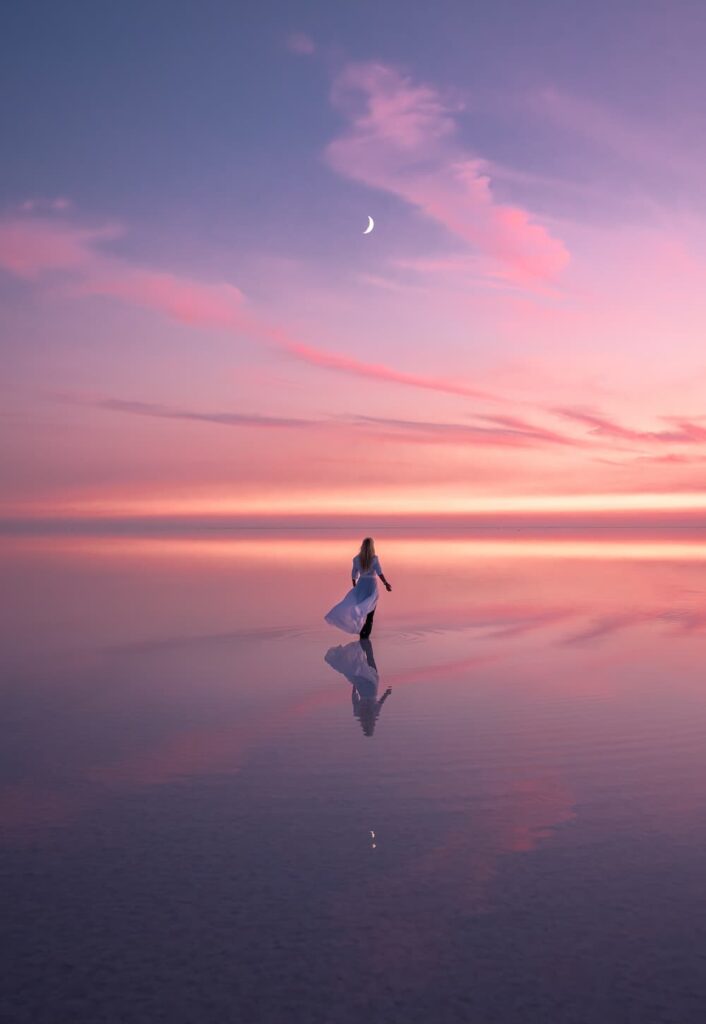
The salt flats of Turkey are stunning. I’m always drawn to landscapes that feel untouched, almost otherworldly — places where you can visually disconnect from reality. The first time I was here, I shot the astronaut project’s photo in pink tones. This time, I just wanted to explore how nature unfolds across that huge mirror. To capture the vastness of space. To capture infinity. And this place is exactly that. There’s something surreal about seeing the sky reflected so perfectly on the ground. It gave me that sense of flying. It’s a location that strips everything down to the essentials: space, light, and the quiet presence of a human within it.

I had no storyboard, no strict intention — but there was an idea: to capture freedom: that endless feeling, the quiet, the openness. Still, the moment completely surprised me. The light shifted from a pure white mirrored scene to an unreal sunset, with wild colors reflecting clouds and textures. It felt like I was just there to witness and capture nature’s canvas and creation. I think that’s when you know you’re in sync with the space — when you’re not forcing anything, and suddenly, the magic unfolds on its own.
An image always comes together through the landscape, nature’s behavior, and the photographer. It’s always a dance between these factors. The landscape is the canvas, nature creates the artwork, and I add the composition and the subject.

I love including a subject to give a sense of space and emotion. I’m drawn to symmetry and composition because they create harmony — a feeling of peace, subtlety, and calm energy when you look at the scene. Composition plays a significant role in shaping how people emotionally experience an image. I intentionally leave a lot of negative space, because that’s where the emotion breathes. Sometimes, what you leave out of the frame is just as important as what you include. I like to keep my photos clean, removing small distractions that might pull attention away from the subject or disrupt the overall sense of symmetry.
For the post-processing, I let the photo guide the direction. I had a general feel in mind — calm, soft, spacious — but I didn’t want to over-edit or manipulate the atmosphere. The natural colors were already beautiful, so I simply enhanced the tones to reflect how it felt to be there. Color is one of the most instinctive tools we have as visual storytellers. I don’t think in terms of technical color theory — I think in mood and emotional tone.
I try to stay true to the natural palette of a place, but I do pay close attention to how different hues work together, whether they create tension or harmony. In this case, the colors were already speaking the language I wanted to use. The light gave me different hues at different moments — from a peaceful white, pure and minimal, to a burst of sunset colors mirrored on water, and finally to the soft twilight tones that closed the day.
Even the moon made an appearance in the end. Magical, isn’t it? For me, editing is about subtlety, not transformation.
Currently, as you can see in the winning image, I’m drawn to wide, open spaces — mostly in nature. However, the underwater world has become my favorite playground lately. I’ve always loved natural light — the kind that doesn’t scream for attention but gently transforms everything it touches. I’m inspired by the idea of creating images that can move something in you on a deeper level. Provoke a feeling of connection. I love showing my appreciation and sense of synchronicity with nature — that quiet co-creation, where you let the moment unfold and simply capture its beauty without trying to control it. That is the path I’m currently walking, and I am fully open to seeing where it brings me next.

Join us in the Azores for a unique photo tour, where you’ll elevate your creative skills with expert guidance from Ronald Soethje, Bruno Ázera, and Nomadict.

In this article, Forest shares how years of chasing scale, silence, and raw landscapes shaped his approach to photography, from the deserts of Kazakhstan to the volcanic ridges of Iceland. He talks about how he uses light, texture, and vast negative space to create images that feel both intimate and overwhelming.

Simon shares the journey behind his photography, from early inspirations to field techniques, editing, and the story of the winning shot that shaped his path.

In this article, Miro shares how his love for cinematic music evolved into a deep passion for photography and how he uses light, color, and atmosphere to turn the streets of Prague into living film scenes.

In this article, Stefanie reveals how her background in physics sparked her passion for astrophotography and how she blends science with creativity to capture the beauty of the night sky. Readers will discover her approach to color, contrast, and editing, as well as her aurora photography workflow.

Spanish photographer Yhabril captures the profound connection between humans and the mountains that shaped him. Growing up in the Pyrenees, his work bridges outdoor sports, landscapes, and celestial scenes — often blending athletes, moonlight, and wilderness into striking visual stories.

In this article, Ariane shares how photography helped her navigate personal challenges, connect authentically with people and animals, and develop a philosophy rooted in empathy and artistic freedom. Readers will also discover her ethical approach to wildlife photography and her trusted equipment for both camouflage techniques and cameras.

Discover how to photograph Dutch tulip fields in their most magical light. From choosing the right gear and lenses to mastering composition, color, and aerial perspectives, this guide shares creative techniques to capture the beauty of the Netherlands’ tulips. Learn how light, color grading, and proportion bring emotion into every frame.